Blue is the Warmest Color is screened at the Cannes Film Festival. The movie would win the Palme d’Or on an unanimous vote- the first film to ever do so.
The American Library Association (ALA) is a library collection guide that was created so that libraries could have a comprehensive and scholarly list of literature to purchase for their library. This idea of a universal guide for all American libraries was championed by Melvil Dewey, the creator of the Dewey Decimal Classification. It was first revealed at the Chicago World Fair in 1893 and has been used as a valuable resource for librarians since that time. It is especially pertinent to the study of LGBTQ+ representation in the media because these lists had a massive pull in what libraries would order and display. Reviews done for books with LGBTQ+ material in it displayed the feelings of that time. In the 1920s, words like “sinister” and “daring” were used to describe books with a lesbian motif in reviews for the A.L.A Catalog. It was rare for libraries pre-Stonewall era to acquire books with adequate representation of the LGBTQ+ community as they heavily relied on mainstream reviews and book lists for their collection. The librarians’ own prejudices also influenced the purchasing of collections. In 1908, the president of the A.L.A. Catalog stated that the New York Public Library, where he worked, would not purchase books that he deemed were “immoral or so indecent that they are unfit to be circulated in the general public.”
This French film debuted in 2013; its focus was a romance story between two women and ultimately a coming-of-age narrative from a queer perspective. The film was controversial, mainly for its depiction and representation of female sexuality and pleasure. The film won the Palme d’Or,an award of the highest praise at the Cannes Film Festival, making history as the first ever film to win through a unanimous vote. This award came just days after France legalized gay marriage.
The role of the media plays a crucial role in the history of LGBTQ+ visibility. Though the medium of film, stories and ideas are able to presented in an artistic, engaging way that brings a narrative alive before one’s very eyes. The things we see (or don’t see) in movies have the power to make a massive impact on our fundamental views of ourselves and our place in the context of the world. Visibility in this sense is a visceral reaction; the literal act of seeing representation on screen. However, it is important to discuss the censorship which occurs in the movie industry and how this affects the kinds of films and themes we, as the general public, are exposed to.
The Motion Picture Association of America (MPAA) is an American film company, which is known for its film acceptability rating scale of General, Parental Guidance and Restricted, which is an essential aspect of all American films. This system, originally named the “Production Code”, was introduced in 1930 as a set of moral guidelines that deemed what was considered “acceptable” for certain film audiences. This rating system imposed restrictions on scenes with explicit language, passion or what they called “sexual perversion”, which harkens back to the 1932 DDC description of homosexuality under the category of Sexual Perversions. Even though this system was supposedly meant to protect the public from “immoral” themes, there has been a long-standing history of suppression of LGBTQ+ visibility in the movie industry. In this particular archival object, the subject of “Lesbians wanting children” garnered the film a “Not G” rating. There is also mention of “Lesbianism” included as one of the reasons for the R rating of language.
These restrictions on visibility have direct effects on the type of narrative expressed in movies. While not outright banning these movies, these ratings send a message that films with LGBTQ+ themes are somehow too immoral for the general public. Censorship of LGBTQ+ visibility in film perpetuates negative cultural conceptions surrounding self-identity and sexuality.
The Dewey Decimal Classification (DDC), published in 1876 by Melvil Dewey, is a cataloging system used by public libraries around the world to categorize different topics of literature and media. In 1932, the first appearance of terminology relating to LGBTQ+ topics was included in the DDC. The term ‘homosexuality’ appeared under either the number 132: Mental Derangements, or under 159.9: Abnormal Psychology, specifically 159.9734746: Sexual Inversion/Homosexuality. This definition reinforced negative cultural conceptions surrounding sexuality and identity expression as something unnatural. Stories with “homosexual” subject matter were seen as taboo and these experiences were not able to be seen and heard by the general public.
The large presence of libraries in society plays an immense role in the public’s awareness and perception of certain topics and experiences. The DDC was and still is the dominant cataloging system used by public libraries across the country, so their categorization of the term “homosexuality” has direct consequences in how queer literature is and was perceived and represented to by millions of Americans. Libraries play an immense role in community outreach and education and have the ability to shape cultural and social norms.
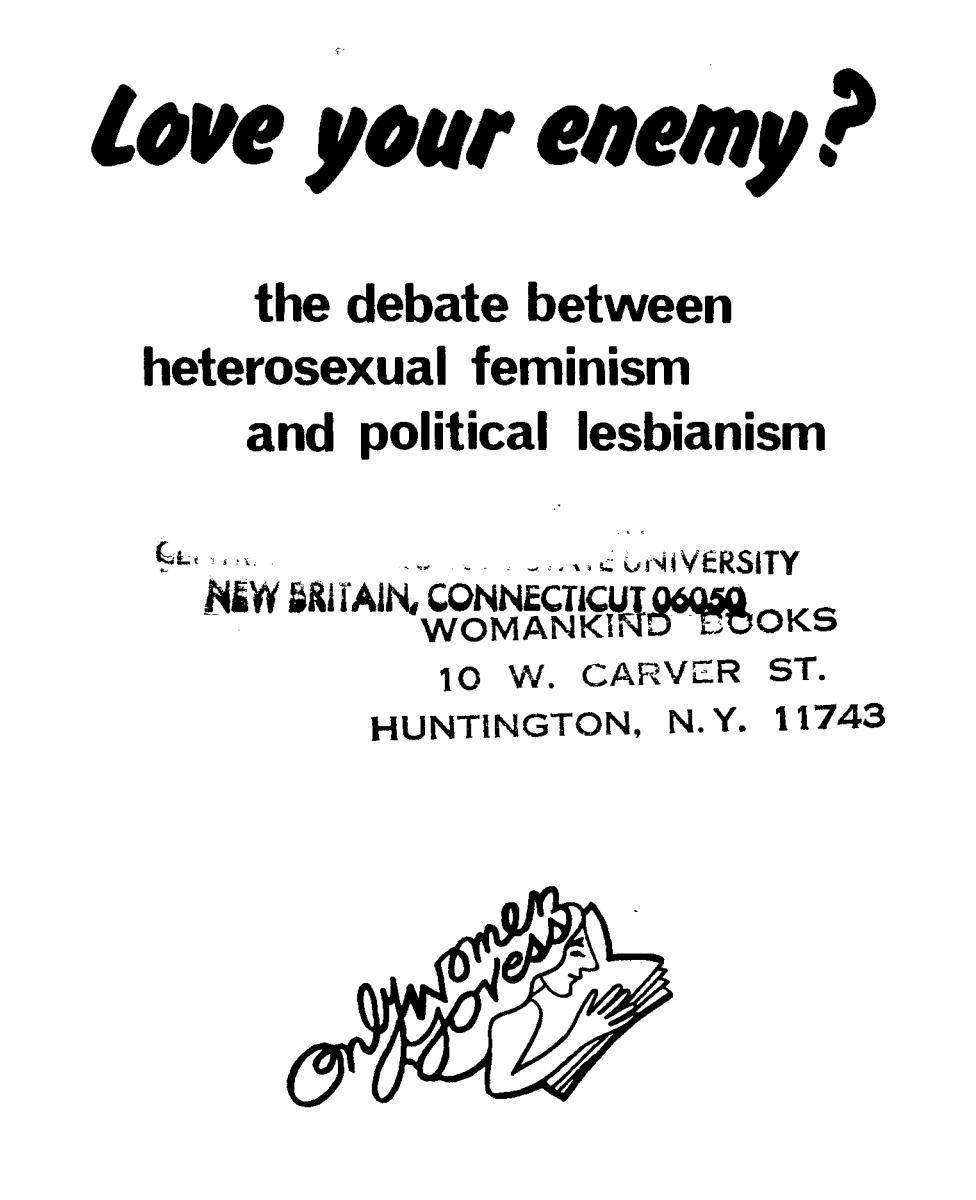
In April of 1981, the British Leeds Revolutionary Feminist Group wrote a paper titled “Political Lesbianism: The Case Against Heterosexuality”. In this paper, the group stated that “all feminists can and should be political lesbians”, coining the term “political lesbianism”. This term was used to describe a “chosen” type of lesbian. These activists believed that all women should be political lesbians, even if they were attracted to men, by actively choosing not to have sex with men.
https://materialfeminista.milharal.org/files/2012/10/Political-Lesbianism-The-Case-Against-Heterosexuality-LRFG.pdf The first page of “Political Lesbianism: The Case Against Heterosexuality”
The Lavender Menace Zap was a protest organized by a group of lesbian activists named the RadicaLesbians. They organized after Betty Friedan, the founder of The National Organization for Women, referred to lesbians as a “lavender menace”. To protest the erasure that they experienced in women’s organizations such as NOW, these activists attended The Second Congress to Unite Women on May 1, 1970. Here, they turned off the lights and appeared onstage with “lavender menace” T-shirts. This event was the beginning of a new era in which lesbian concerns began to be taken into account in women’s organizations.
http://web-static.nypl.org/exhibitions/1969/radicalesbians.html “The Lavender Menace” by Diana Davies
This is a template for your first post! Click “edit post” on the upper bar, or go to Dashboard>Posts>All Posts and click the title above to edit the content.